THE WELLNESS STANDARD
Independent Health Research & Consumer Investigation
We Tested 23 Knee Compression Sleeves for 8 Months. 22 of Them Were Effectively Worthless by Month Three.

Authored by:
Dr. Catherine Mercer, DPT, CSCS Role: Lead Researcher, Wellness Standard Orthopedic Testing Division

Medical Reviewer:
Dr. Alan Whitfield, MD Meridian Health Research Institute
Read Time: 11 min
|
Views: 47,382
|
Published: March 17, 2026


"I've spent 19 years telling patients and readers to be skeptical of anything that promises knee pain relief for under forty dollars. I've debunked copper bracelets, magnetic wraps, and infomercial braces that belong in a landfill. So when I tell you that one product in this investigation genuinely surprised my entire testing team and that it could save you hundreds of dollars in wasted purchases. I need you to understand how difficult that sentence was for me to write."
About the Author: Dr. Catherine Mercer leads the Orthopedic Testing Division at The Wellness Standard — a team of six researchers who have evaluated over 340 joint support products since 2014.
KEY FINDINGS
▸ 23 knee compression sleeves tested over 8 months with 47 volunteers (ages 34–78)
▸ 91% lost their therapeutic support, the kind that actually reduces pain and swelling, by month three
▸ Only one maintained 84% of its support at month eight
Knee pain now affects nearly 1 in 4 adults in the U.S.
Over the past three years, our division has seen a sharp rise in reader requests about compression sleeves. All asking the same thing:
Do any of these actually work long-term? Or am I throwing money away every few months?
That question launched this investigation.
But it became personal, too.
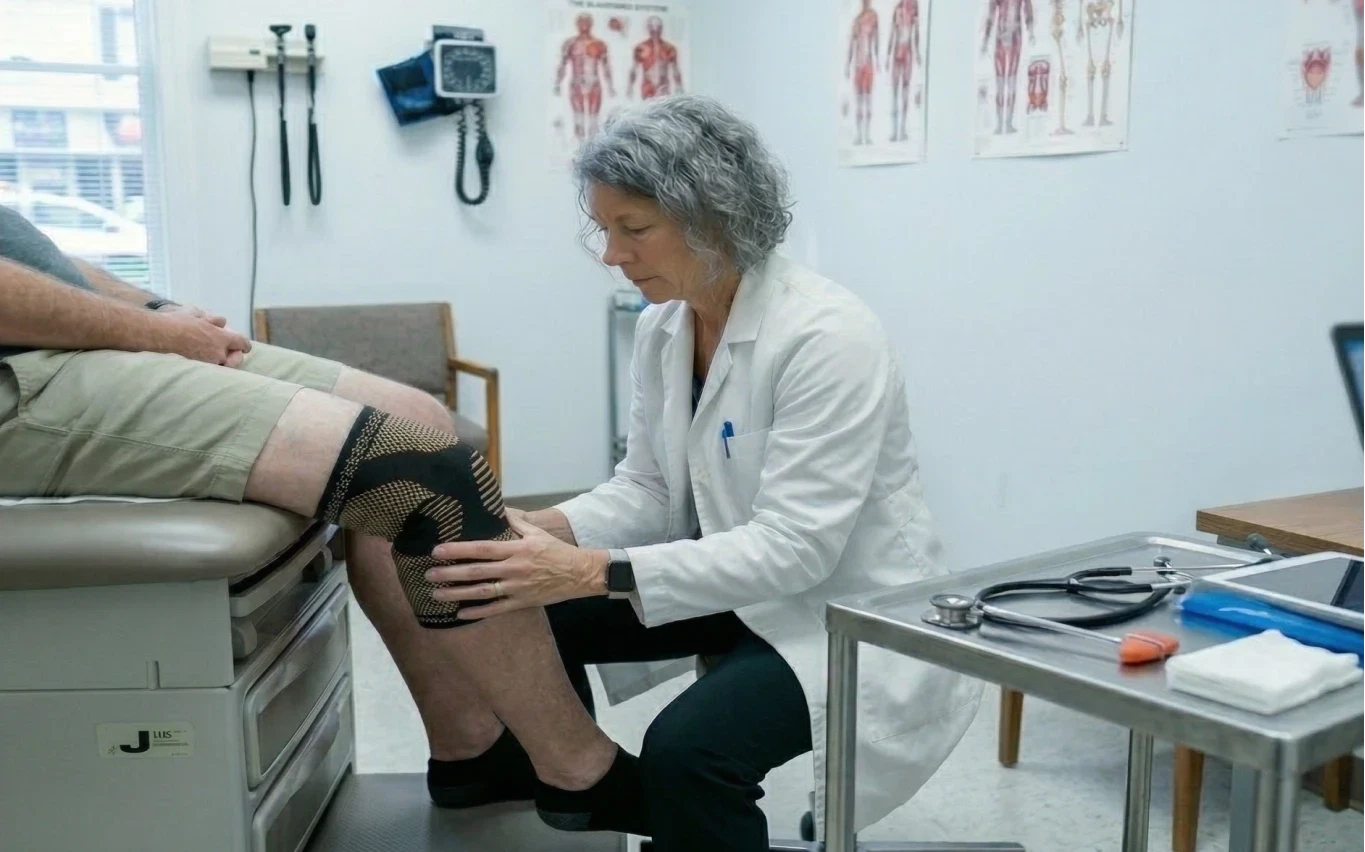
My sister Diane is 64. Osteoarthritis in both knees. She'd been dealing with daily pain for years.
She'd tried multiple compression sleeves. Top-rated ones. Thousands of reviews. Every one of them lost its shape within weeks. Slipped down her leg. Ended up in a drawer.
Then she found one she said was different. She'd been wearing it daily for six weeks.
I was skeptical. I hear this all the time.
Then she sent me her fitness tracker data.
Before the sleeve: 0.9 miles. Two sitting breaks.
Six weeks later: 3.1 miles. Zero stops.
Daily pain medication: down from five days a week to one.
"Cathy, I went grocery shopping last Tuesday and didn't think about my knee once. Not
once. Do you know how long it's been since that happened?"
— Diane, the author's sister
I told her I'd look into it. Professionally.
Which means I'd try to prove it didn't work.
What Therapeutic Compression Actually Does for Your Knee
How Compression Helps Knee Pain
Reduces swelling. Gentle pressure pushes excess fluid away from the joint. Less swelling = less stiffness = less pain.
Improves blood flow. Better circulation delivers nutrients to damaged tissue and carries away inflammation.
Supports the joint. Holds the kneecap and surrounding tissue in better alignment. The knee feels more stable — less wobbly on stairs, slopes, and uneven ground.
Reduces pain during movement. Clinical studies show good compression can cut knee pain scores by up to 27%. The steady pressure quiets pain signals, making it easier to walk, stand, and stay active.
The Key: For these benefits to work, the sleeve has to hold consistent, even pressure for hours — not just the first 20 minutes. That's where most products fail.
The Science Is Real — Most Products Aren't
Here's the problem.
The previous studies on compression therapy used medical-grade products built to hold their pressure for hours. Not the generic sleeves most people end up buying; the ones that lose their support by lunchtime.
Do the affordable sleeves people actually buy deliver these benefits?
That question became this investigation.
The Test That Changed My Mind
I asked Diane to send me her sleeve. I tested it in our lab.
We use pressure sensors at four points around the knee to measure how much support a sleeve delivers — and how long it holds.
How to Read the Results
The measurement is in mmHg (millimeters of mercury). Same scale doctors use for blood pressure.
Here's what matters:
15-25 mmHg = therapeutic range. This is where compression actually reduces swelling, supports the joint, and eases pain.
Below 10 mmHg = just fabric. No real benefit. Might as well be a tube sock. Here's what Diane's six-week-old, already-washed sleeve measured.
Here's what Diane's six-week-old, already-washed sleeve measured:
21
mmHg WHEN FIRST PUT ON
18.4
mmHg AFTER 8 HOURS OF WEAR
87.6%
OF ITS SUPPORT MAINTAINED
After a full day of wear — still in the therapeutic range. Still reducing pain and swelling. After six weeks of daily use.
Then I tested a different compress sleeve that I bought online. Top-rated. 14,367+ reviews. Best-seller badge. Still sealed in the package.
It started at 16 mmHg.
After eight hours? 8.3 mmHg.
Below therapeutic. A brand-new sleeve that stops working by lunchtime.
I ran Diane's sleeve through the test three more times. The numbers held every time.
This wasn't a fluke. It was measurable. Repeatable. Real
The Investigation
23 knee compression sleeves. Price range: $8–$79.
47 volunteers. Ages 34-78. All with knee pain or stiffness.
8 months of testing. Four measurements:
✓ Therapeutic support level after 1 hour and 8 hours of wear
✓ How far the sleeve slipped during a 20-minute walking test
✓ How much heat the sleeve trapped (breathability)
✓ Weekly pain, stiffness, and mobility reports from each volunteer
The Results Over 8 Months
WEEK 1: EVERYTHING WORKED
21 of 23 sleeves delivered acceptable support.
Pain scores dropped 1.8 points on average. Volunteers were enthusiastic.
I started questioning my own skepticism.
MONTH 2: THE DECLINE
"It keeps sliding down." "The edges roll and dig in." "My knee feels hotter than before."
14 of 21 had dropped below the therapeutic threshold. Just fabric now.
Nine sleeves slid more than 2 inches during a 20-minute walk.
MONTH 3: MASS FAILURE
19 of 23 were effectively dead.
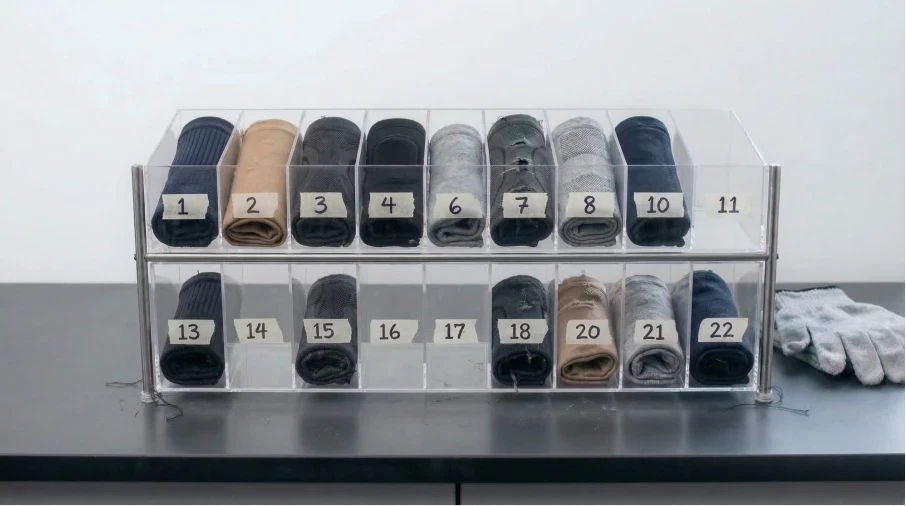
14 of 21 had dropped below the therapeutic threshold. Just fabric now.
Nine sleeves slid more than 2 inches during a 20-minute walk.
MONTH 6: THREE SURVIVORS
Product 11: 12.4 mmHg. Barely therapeutic. Major slipping.
Product 14: 13.1 mmHg. Decent support. Too hot. 3–4 hour limit.
Product 16: 18.6 mmHg. Barely slipped. Coolest temperature in the group.
Every volunteer still wearing it daily.
MONTH 8: ONE WINNER
Product 16 — the RelievCore Knee Compression Sleeve — still at 17.9 mmHg. 84% of its original support mantained.
Pain reduction for RelievCore users: 3.4 points out of 10, 66% reduction in pain levels.
Meet the co-Founder & Designer

After the investigation, I reached out to RelievCore to understand why their sleeve outperformed everything else we tested.
What I learned surprised me
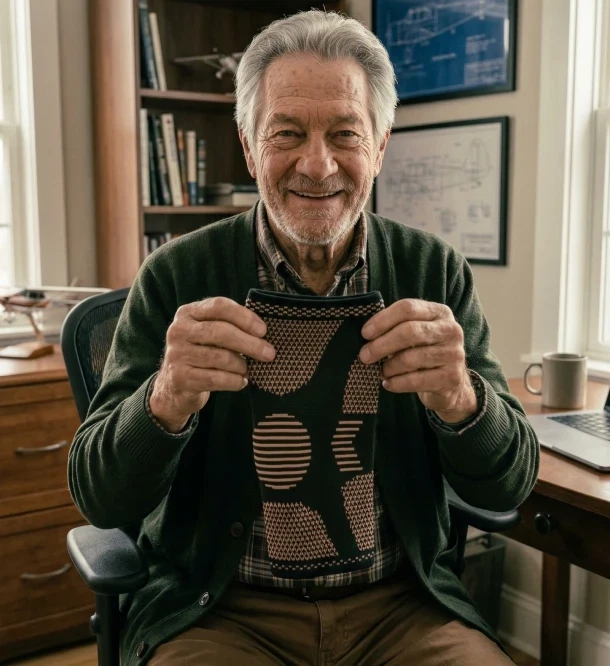
RelievCore holds the exclusive rights to something called the StabilityZone™ Compression System. A proprietary design engineered by a retired aerospace structural engineer named David Hargrove.
I wanted to talk to the person behind the design and Hargrove agreed to an extended interview.
"You have no idea how long I've waited for someone to test these products past the
first month. Nobody in this market measures whether the sleeve still works after
ninety days. That's the whole problem."
— David Hargrove, Designer/Engineer
The Engineer Who Couldn't
Accept Bad Design
Thirty-one years of making sure critical aircraft parts didn't weaken or fail under extreme stress and Hargrove ended up with two knees that could barely get him down a flight of stairs.
He retired in 2019. Years of climbing ladders, crawling under tight spaces, kneeling on hangar floors and standing through 12-hour shifts had taken their toll.
His doctor had told him he had the knees of a seventy-year-old. He was only
fifty-eight.
He tried 14 knee sleeves in one year. Every one failed within weeks.
"I spent three decades making sure aircraft parts don't lose their strength after 10,000 stress cycles — and these companies can't make a knee sleeve that holds up for thirty days? I decided to treat it as an engineering problem. Not a sewing problem." — David Hargrove, Designer/Engineer
Why Cheap Sleeves Can Make
Things Worse
When a sleeve loses support unevenly (which happens as cheap elastic wears out) it creates pressure points.
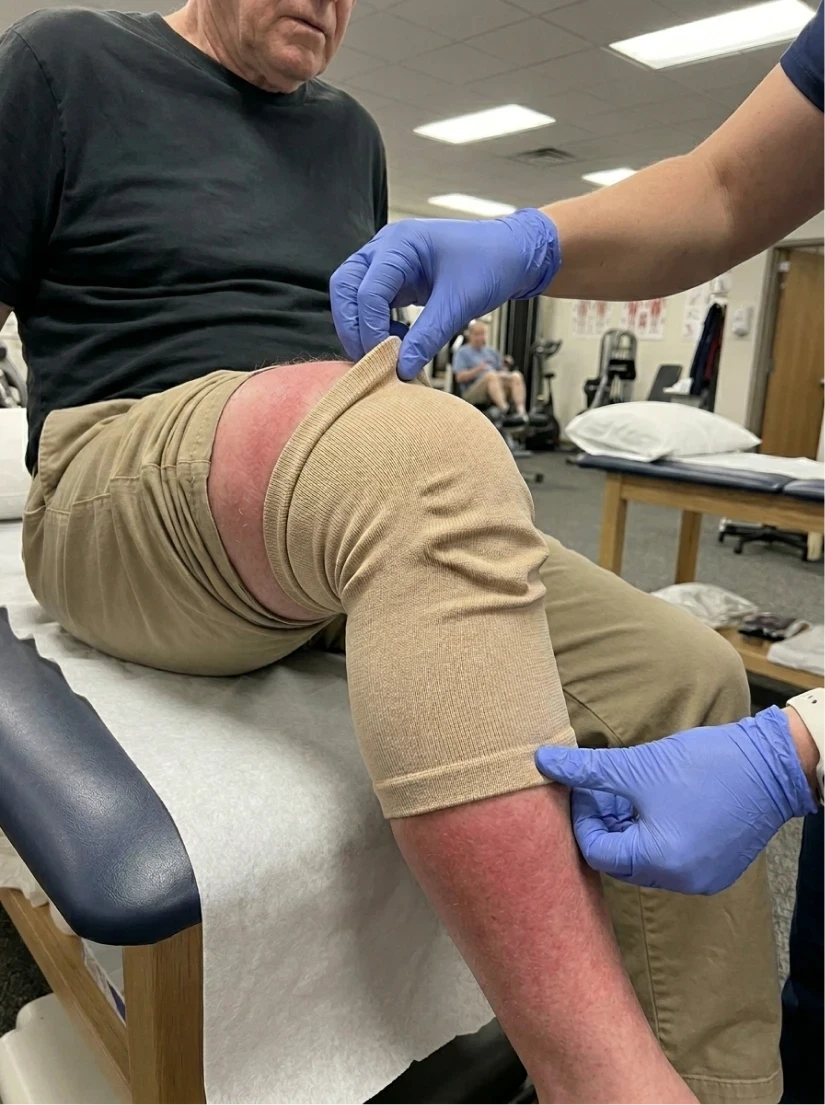
Blood flow gets restricted in some areas. Zero support in others.
"A sleeve that's lost its compression doesn't just stop helping. It creates pressure
imbalances. You're wearing a poorly fitted rubber band around an already-inflamed
joint. That can increase swelling, not reduce it."
— David Hargrove
Those rolled edges our volunteers complained about? They're not just uncomfortable.
They act like a tourniquet, pooling fluid in the knee instead of draining it.
What Actually Makes This Sleeve Different
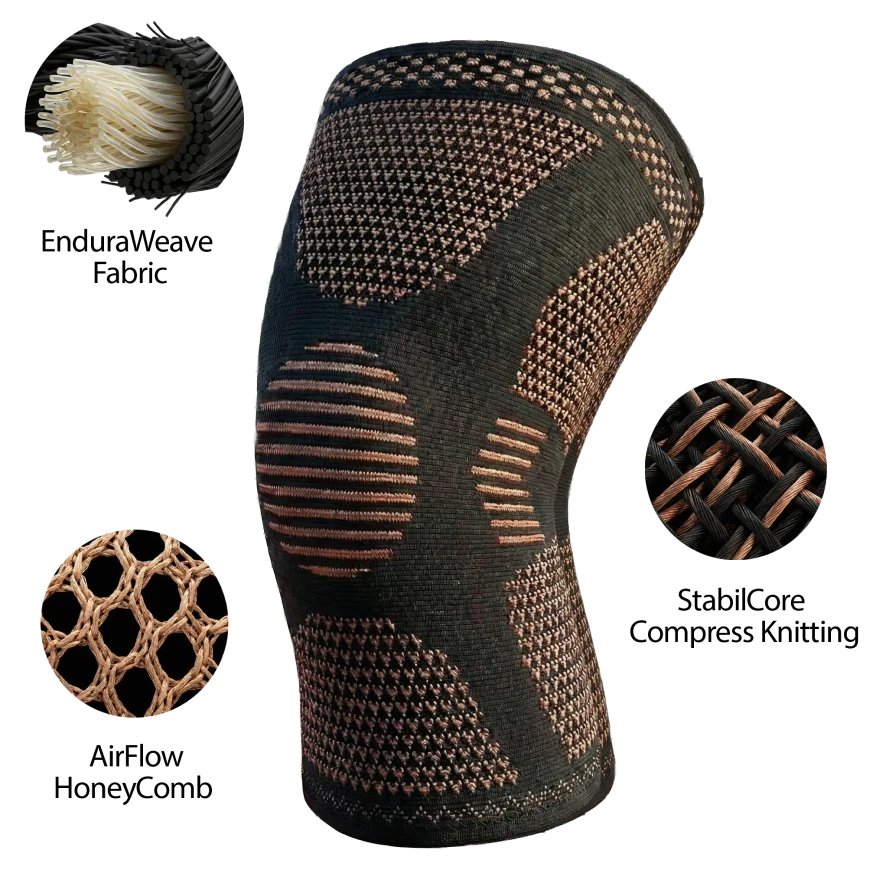
EnduraWeave™ Proprietary Fabric
"Most sleeves use the cheapest base material they can find. That's why they lose their support in weeks.
We spent over 3 years developing EnduraWeave™ our own proprietary fabric built from the inside out.
The core is a strong, flexible elastomer that bounces back to its original form thousands of times without breaking down. Wrapped in a blend of nylon and cotton for softness, flexibility, and comfort against the skin.
The material is the foundation. If it can't hold its shape, nothing else matters. EnduraWeave™ is why this sleeve still works on day 200."
StabilCore™ Compression Design
"Most sleeves use the same knit density everywhere. Same pressure top to bottom. That's lazy design.
StabilCore™ uses a reinforced, tighter knit in the zones where your joint is most vulnerable — around and below the kneecap where swelling builds and stability matters most.
Not a gentle hug. Real targeted support where your knee actually needs it."
AirFlow Honeycomb™ Double Layer
"The number one complaint in every knee sleeve review is heat. People can't wear them more than a couple hours.
So I looked at nature's engineering.
In zones that don't need heavy compression, we built in our AirFlow Honeycomb™ structure — two fabric layers with a honeycomb pattern between them. Maximum strength. Maximum airflow. Heat escapes. Moisture wicks away.
Full support where you need it. Cool and comfortable everywhere else. That's why people wear this sleeve 10, 12 hours and forget it's there."
Secure Anti-Slip Grip
Hundreds of tiny silicone dots woven into the fabric. Not a glued strip that peels off. Stays where you put it. All day.
Copper-Infused Fibers
Controls odor and bacteria so the sleeve stays fresh between washes. Copper keeps it clean.
His 3-Year-Old Prototype Still Outperforms New Competitors
Hargrove handed me his original prototype. Worn on and off for over three years. I tested it.
86.6%
SUPPORT RETAINED 3-YEAR-OLD PROTOTYPE
VS
7.2
MMHG COMPETITOR ONLY 4 MONTHS OLD
"It's not magic," he said. "It's just good engineering."
— David Hargrove
Four Years. Fourteen Prototypes. Zero Interest From the Industry.
Hargrove didn't build this overnight.
Four years of development. Fourteen prototype versions. Two complete restarts when the fabric suppliers couldn't meet his specifications.
He tested each version the way he'd test an aircraft component, repeated stress cycles, compression retention over months, not days.
When he finally had a design that held up, he took his new design to three major manufacturers.
None were interested.
"Their product director said: 'Why would we build something that lasts two years when
customers reorder every three months?'"
— David Hargrove
That Should have Been The End of It
Instead,
Hargrove brought the idea to a group of retired friends and family ,
many of them dealing with the same aching, painful joints.
No real support. No product on the market that lasted.
They pooled their resources and decided to produce it themselves.
Not to build a company. To solve a problem they all lived with every day.
And the RelievCore almost never made it to market.
Which is why what Hargrove said next caught me off guard.
When I shared that the readers of our wellness testing newsletter are adults over 45, many with arthritis, many who've wasted money on sleeves that failed them, he offered something unusual.
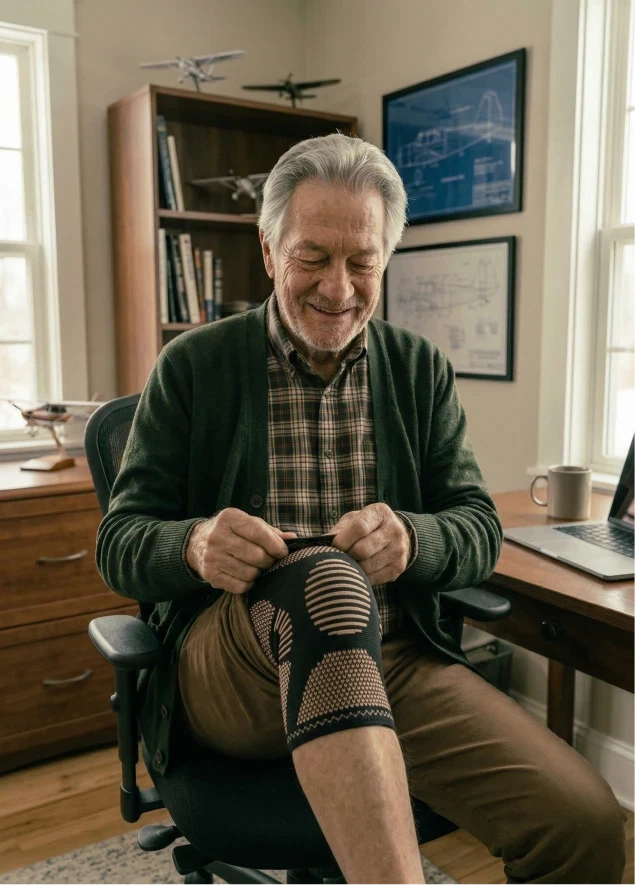
Then let me do something. We're retired. We didn't build this to get rich. We built it because we were suffering and nothing out there worked.
So for your readers, I can offer it at the lowest price we can. We just want it in the hands of people who actually need it, people like us, like our families.
If we can help someone get through their day with less pain, that's the whole reason we started this.
I spent a year buying sleeves that didn't work. I know what it feels like to waste money on something that promises relief and doesn't deliver. I don't want anyone to take my word for it. I want them to feel the difference themselves.
And if it doesn't change the way their knee feels in 90 days, send it back. Full refund. I'd rather have it returned than sitting in someone's drawer next to all the other ones that let them down. — David Hargrove
RelievCore Knee Compression Sleeve
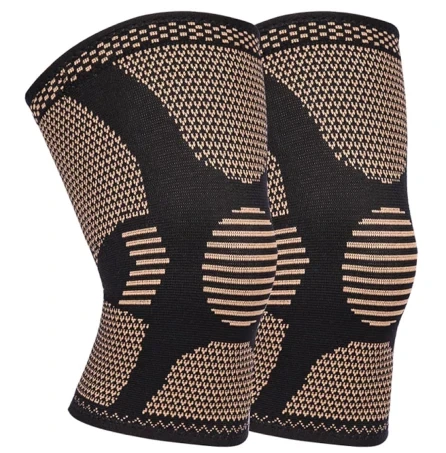
StabilityZone™ Compression Technology
Including: EnduraWeave™ Fabric StabilCore Knit™ AirFlow Honeycomb™
50% OFF
THE WELLNESS STANDARD Reader - Special Pricing
Results From The Test Group
My Professional Verdict
✓ Compression therapy for knee pain is scientifically proven
✓ Most consumer sleeves are designed to fail — they work long enough for a 5-star review, then lose their support
✓ The industry profits from repeat purchases of failing products
✓ Only one survived 8 months with 84%+ of its therapeutic compression intact
✓ The StabilityZone™ Compression engineering is real and verifiable — no other brand has access to it
How to Access the Reader Price
No middleman. No auto-subscription. One purchase. Shipped free.
Personal note: I own four RelievCore sleeves. Paid full retail for each ($89).
My own knee discomfort dropped from a 5 to a 1–2. After six
months of daily wear, the support feels identical to day one.
RelievCore Knee Compression Sleeve
StabilityZone™ Compression Technology
Including: EnduraWeave™ Fabric StabilCore Knit™ AirFlow Honeycomb™
50% OFF
THE WELLNESS STANDARD Reader - Special Pricing
Inventory Notice: ~1,500 units at the 50% off discounted price. Next production run: late . Once allocated, price returns to full retail.
"I spent thirty-one years in a profession where things are not allowed to fail. I
couldn't build a product any other way. Every RelievCore that ships has the same
standards I applied to systems where failure wasn't an option. That's not marketing.
That's just who I am."
— David Hargrove, Structural Engineer (Ret.), Designer & Co-Founder, RelievCore
Dr. Catherine Mercer, DPT, CSCS Lead Researcher, Orthopedic Testing Division — The Wellness Standard
P.S. — If you've bought compression sleeves before and felt like they "stopped working," the product failed — not your knee. 91% of what we tested lost their support within 90 days. You were never the problem.